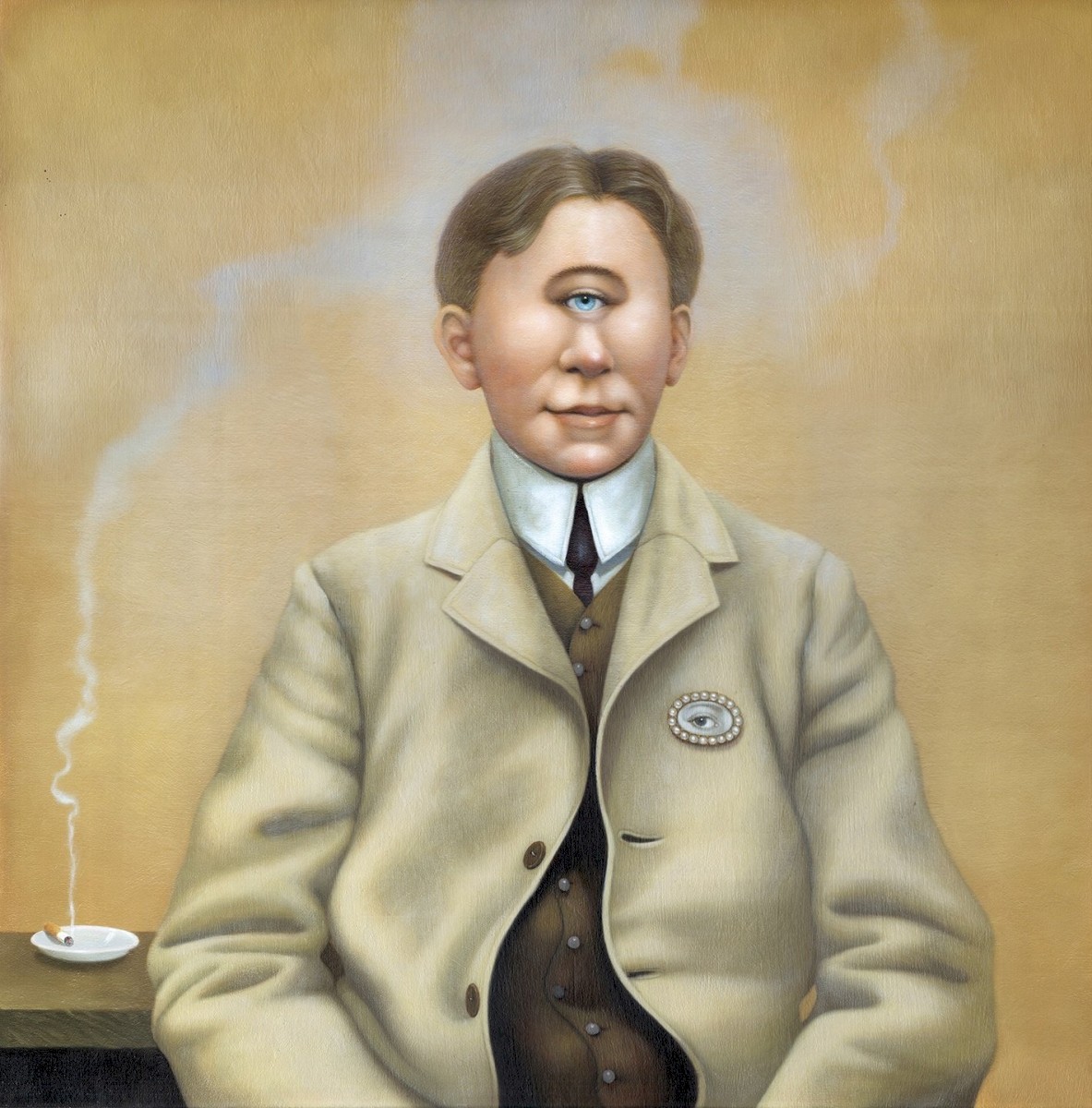
A Beginner's Guide to King Crimson
A 21st Century Perspective
What I like about this band is that what it
is actually doing is not what it appears to be doing" - Robert Fripp
Well, Robert Fripp should know. He is one of the founders (over 50 years
ago!) and the only constant member (to the extent that King Crimson can be
called "constant".) You could say that he is the Crimson King,
although you would never know it from his stage presence, where he sits,
usually in the shadows and off to the side, out of the spotlight. But one
can argue that without Fripp, King Crimson would have disappeared from the
face of the earth soon after they emerged, assuming they ever really did
emerge.
Call me biased: I believe Fripp is one of the towering musical forces
of the second half of the 20th century. I am hard pressed to think of
another with the originality (and output!) he's demonstrated. Frank Zappa
comes to mind, and while some of his work is indeed impressive (and
influential), Zappa created an aura of, well, something less than seriousness
around is music. The closest comparison I can come up with is Philip Glass,
someone totally serious about his music, an original talent who found
(created?) a style that is unique and enduring.
So if Fripp is the Crimson King, what exactly is King Crimson? To answer
that, you have to recognise that there are multiple entities called "King
Crimson". The original, often burdened with the label "Progressive Rock",
is lumped in with contemporaries: Yes, Genesis and others. Indeed, there was
even migration of musicians between King Crimson and other "prog rock" bands,
a couple of them (drummer Bill Bruford, who began with Yes and became as
close as anyone could to being a "permanent" member of King Crimson, lasting until
he retired to pursue an academic career. Every 10 years or so, it seems that
a different "King Crimson" line-up would appear, always with Fripp (who
conjured them back into existence) and with or without former members and
new musicians, as Fripp saw fit.
For convenience, I like to think of four versions of King Crimson:
- The "original" band, which produced "In the Court of the Crimson King",
"Wake of Poseidon", "Islands" and such. These really are the closest to
actual "prog rock", and while they established the band's reputation, I
find them the least interesting period. Still one can't argue that they
didn't create some remarkable music.
- Beginning with the album "Lark's Tongues in Aspic", which contained the
first two installments of the title piece, the band's sound underwent a
radical change (the first attempt at "unseating the monkey mind?") Fripp,
along with drummer Bruford and bassist/vocalist/songwriter John Wetton
and violinist David Cross, created an album that, in the words of
one critic, "you can't dance to, you can't keep a beat to, and it doesn't
even make good background music for washing the dishes." Precisely. This is
music that demands careful listening, with complex polyrhythms and multiple
levels of melodic interplay.
- The third iteration involved the addition of Adrian Belew on guitar.
Fripp has always been a masterful guitarist (if it wasn't for his
compositional skill, he would appear on more "top 10 guitarist" lists),
but Belew, who had worked with David Bowie, the Talking Heads, Frank Zappa
and others,
brought a pop sensibility to King Crimson, taking them in a different
direction while maintaining their exploratory and innovative approach
to music. Belew assumed songwriting duties -- and he indeed wrote "songs"
-- along with providing a strong vocal presence, often appearing to be
the "front man" on stage during live performances. But we know better,
don't we. The albums "Discipline", "Three of a Perfect Pair", "Beat" and
"Thrak" testify to Belew's contributions, along with numerous live
performances, thankfully captured on both audio and video. King Crimson
has always been all about recording their live performances, to my joy and
despair: it's wonderful to have the historical record available, but their
sheer volume can be overwhelming. Also during this period, drummer Pat
Mastelotta joined King Crimson, more or less permanently, as did bassist
(and Chapman Stick player) Tony Levin. The touring ensemble was often
comprised of two drummers (Mastelotto and Bruford) and two bass/Chapman
Stick players (Levin and Trey Gunn), although they appeared variously as
a quartet (one drummer/bassist) or sextet ("double trio" with Fripp and
Belew on guitar.) The two final studio albums ("The ConstruKction of
Light" and "Power to Believe") were produced by the quartet (Fripp,
Belew, Gunn, Mastelotta) supplemented by additional personnel. Taken
as a whole, I would have to call this my favorite period.
- The final iteration, I believe, reflects Fripp's attempt to define
and consolidate his legacy. Bruford had retired; Belew was gone by
Fripp's choice (my guess is that he felt King Crimson no longer needed a
"front man".) Purely instrumental pieces, improvisations, and "sound
scapes" become more prominent. Additional personnel added the ability to
play earlier works, such as "In the Court of the Crimson King", and
adaptations of a few of Belew's compositions, most notably "Indiscipline",
adapted for the new band. More wind instruments (saxophone, oboe, flute)
aided in those efforts. Annual tours (typically with seven or more
musicians, often including three drummers) and a constant stream of live
performance releases, box sets, "official" bootlegs, "audio diaries" and
compilations continue to appear, but so far no new studio albums or new
material. But then, King Crimson is known for never playing the same
concert two nights in a row. And just based on the sheer amount of work
available, what better time could there be to "discover" King Crimson.
So on to the playlist. I confess it's heavily weighted to the third
iteration of the band. I am a huge fan of innovative electric guitar, and
Adrian Belew is one of the best. In his live performances, you can see how
far he takes his technique outside of the range of the "normal". I had
comparisons to Hendrix, but Belew does manage to get sounds from his
guitar that few before him could, which was, after all, Jimi's claim to
fame. Plus both were strong songwriters. But I digress.
The list starts with a couple of "late early period" items, and moves
in a not-entirely-chronological order through some of my favorite pieces.
It ends, as it only could, with a classic from the first album. Enjoy!
Here is a link to the playlist on YouTube
- Red This really signaled the direction KC would be taking
from here: more guitar, less saxophone. Pre-Belew, definitely not pop, but
set the tone for more extended instrumentals to come. You can find covers
of this on YouTube for piano, accordian, and string quartet.
- Starless Written by bassist Wetter, this was originally intended
to be on the "Starless and Bible Black" album, but Fripp deemed it "not
quite ready." The band honed it into its current form over a series of
live performances, and it has remained a standard to this day. I have to
say that my first impression was not positive, but it has really grown on
me since.
- Fracture This is the piece that Fripp himself deemed "impossible
to play" and if you listen carefully to the guitar part, it's easy to see
why. One guitarist on YouTube spent 22 years failing to learn it (and wrote
a book about the experience called "Failure to Fracture") and Fripp claimed
when it was on their concert playlist he spent 60% of his time rehearsing
it. All that said, it stands on its own merits as a musical composition
(and performance.)
- Indiscipline For many years, the only King Crimson album I owned
(yes, vinyl, it and I are that old) was "Discipline" and this is the
"anti-title" track, a spoken tale of obsession ably performed by Adrian
Belew and his guitar (not to diminish the contribution of the frenetic
percussion that sets the stage for the ensuing madness.) I like it. Later
iterations of the band have done this with sung (rather than spoken) lyrics,
to diminished effect (to me, at least.)
- Discipline Instrumental, musically related to the previous, but
a different tone and effect (as you would expect.)
- The Sheltering Sky Another side of "Discipline".
- Frame By Frame Yet another side of "Discipline". I think the
wide stylistic range is why this remains one of my favorite albums of all
time.
- One Time Belew wrote songs that, with another band, in another
time or place, would have gotten heavy airplay and charted. It's really a
sin that so few people are familiar with this (and the next three.)
- Dinosaur This surely is my theme song. Heartfelt lyrics,
amazing guitar work. Was released as a single at the time, as it should
have been, but...
- Heartbeat "Beat" was an interesting album, inspired by Jack
Keruoac and company. This is definitely a high point, a beautiful love song.
- Three of a Perfect Pair One of those songs that gets into your
head. Lot's of speculation on YouTube about the details, and what the
"third" part of the pair is, but I think it's a simple (and moving)
chronicle of an unhappy relationship.
- Lasks' Tongues in Aspic, Part I This is the beginning of a
musical journey that has lasted decades. Parts I and II appeared on the
eponymous album, with III, IV and V following (V is actually "Level V"
from "The Power to Believe", related numerically, musically and by
assertion by Fripp.)
- Lasks' Tongues in Aspic, Part II This (and to a lesser extent
part I) are concert regulars to this day. On some versions you can hear
the larks, which is a little disturbing.
- Lasks' Tongues in Aspic, Part III Probably my favorite of the
first three "Larks" but I will listen to any of them, any time. More
up-tempo and fewer birds.
- The ConstruKction of Light Wonderful update of Hamlet's "What a
piece of work is man". "If god is dead, what am I? A speck of dust on the
wing of a fly." Exploring our place in the world and the nature of
reality itself. And that's just the coda. In many live performances the
lyrics are left off, and I miss them, but the music stands well on its own.
- The World's My Oyster Soup Kitchen Floor Wax Museum Belew says
that Spike Jones ("We Heil! Heil! Right in der Fuhrer's Face" and "Cocktails
for Two", yes, that Spike Jones) was one of his influences. As if to prove
the point...
- FraKctured A follow-on to "Fracture" yet not the same. Probably
every bit as difficult to play.
- Larks' Tongues in Aspic, Part IV Includes the (sometimes omitted
in live performances) coda "I have a dream...", it not only explands (and
for a while, concluded) the "Larks" saga, it stands as a pair with "The
ConstruKction of Light" in format and tone.
- Level V From (so far) their last studio album (and one of their
best) it concludes (for now) the "Larks" cycle. While not as obvious a
follow-on, and standing quite well on its own, there are musical
similarities (which mostly, I confess, go beyond me.) Another one you
can find piano (and other) covers on YouTube.
- Happy With What You Have To Be Happy With A send-up of pop music
by the most "pop" of all band members (Belew). "We're gonna have to write a
chorus!"
- Dangerous Curves Maybe Ravel should be included among Fripp's
influences? Like "Fracture" it starts quiet and builds.
- In the Court of The Crimson King What more is there to say about
this. It is what it is.
I am listening to this playlist as I write this. I have to stop, because
every song makes me want to write more, and I have already spent to much
time on it. I might get back to it later. Or another playlist. And another
post.